
Getting Old World style without trying requires layering honest materials, utilizing authentic craftsmanship, and building a room around a few character-rich focal points rather than matching sets.
By anchoring the space with reclaimed wood furniture, adding historical wall decor, and incorporating warm ambient lighting, a room naturally achieves a collected and historically grounded atmosphere.
Old houses have a way of making requests of their inhabitants. The worn brick above the fireplace wants something with weight beside it, and the wide-plank pine floor is asking for furniture that understands what it has been through.
The painted trim with its dozen coats of history is already telling a story, and the right decor naturally finishes the sentence.
This is the quiet appeal of old-world home design. It does not begin with a mood board or a shopping cart, but with an instinct that a room should feel collected rather than coordinated.
The spaces that pull this off best are layered, built around genuine craftsmanship, and a handful of pieces with enough character to carry the room.
Building an industrial farmhouse atmosphere from the ground up relies on a specific sequence. It starts with a heavy anchor piece, moves to adding an edge to the walls, and finishes by letting smaller tactile details do their atmospheric work.
Start With an Anchor Piece That Earns Its Place
Every room that feels genuinely collected starts with one honest, well-made piece that sets the standard for everything around it. In a dining space, that piece is almost always the table.
It sets the architectural register for the whole space, acting as a gravitational center for the room’s aesthetic. When sourcing these foundational pieces, look at Knox Deco’s industrial dining tables. Specialized furniture makers provide excellent examples of this design philosophy.
For an industrial farmhouse dining room, the anchor needs to be built from materials that have already lived somewhere.
A U.S. Forest Service survey found that among consumers aware of reclaimed wood, the top motivations for choosing it were to promote sustainability, for the aesthetics, and because there was a need.
Pairing a reclaimed top with a heavy-duty cast iron or steel base explains the room’s entire aesthetic in a single piece. Raw steel echoes wrought-iron window hardware, while dark powder-coated finishes rhyme with aged trim.
Designs inspired by early American factory machines serve as functional industrial heritage rather than mere novelty. The ability to adjust the table height means the piece adapts to daily life.
A room styled around the collected philosophy needs at least one piece built to heirloom standards that is actually worth keeping for a generation. Give the table room to breathe before adding anything else.
Pro Tip: Prioritize materials with a past. Reclaimed wood and cast iron don’t just fill space; they provide an architectural foundation that dictates the quality and “collected” feel of every other piece you add.
Give the Walls a Story Worth Telling
Once the table is in place, the walls have to meet the standard it has set. This is where most well-intentioned rooms default to safe, forgettable choices that do not give the eye anywhere interesting to go. The rooms that stick with you do something bolder by putting something on the wall that earns a second look and starts a conversation.
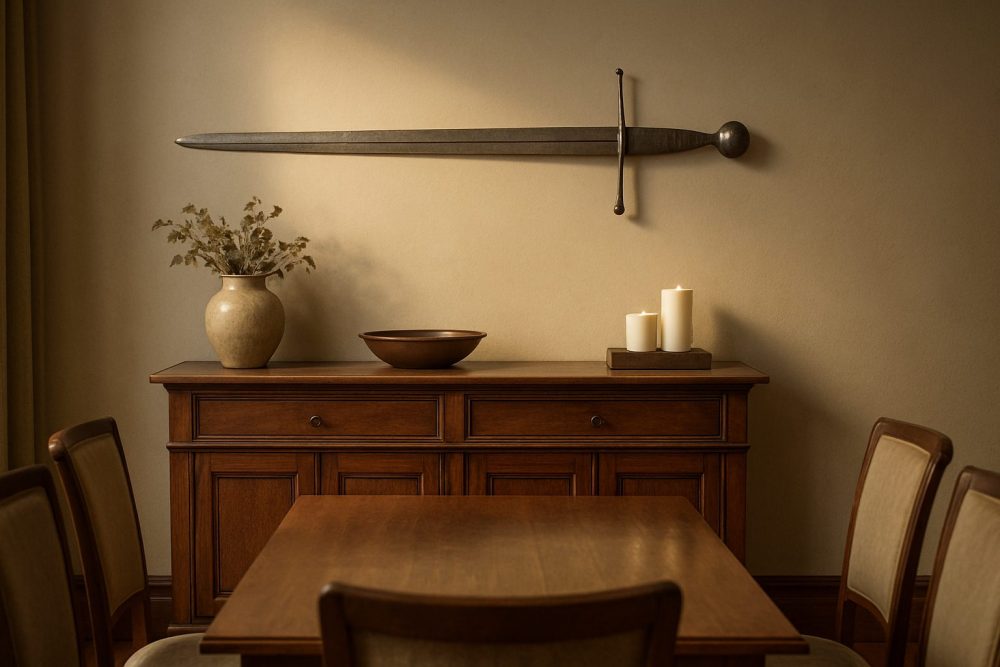
Consider the case for displaying historically inspired weaponry as statement wall decor.
The metalwork of well-crafted swords from Medieval Collectibles echoes the industrial tones of the reclaimed table below it. The cross-guard, the pommel, and the aged steel of the fuller create a tight aesthetic logic with the historical character of the room.
The key is restraint and intentionality in display to keep the look refined.
A single statement blade above a sideboard or credenza changes the entire register of a wall when centered and mounted horizontally. It becomes an immediate focal point that draws people in rather than merely filling blank space.
A curated gallery wall can also act as the room’s anchor. Mix an antique-inspired blade with framed black-and-white prints, an aged mirror, and one or two botanical sketches.
Keep the metalwork as a single element among many, and the overall effect reads as a highly refined collection.
When mounting historical pieces, they should be treated with the care of heavy wall art. Use brackets specifically rated for the weapon’s weight, and mount them into wall studs wherever possible. Museum-style display mounts offer a clean, gallery-appropriate installation.
Warning/Important: Always use wall anchors or mount directly into studs when hanging heavy historical decor. Professional-grade brackets ensure these statement pieces remain secure focal points without risking safety or damaging your home’s walls.
Layer the Atmosphere – Old World Meets Workshop
Alt: Stacked plates and vintage pitcher on rustic table.
The table anchors the room, and the wall decor gives it an edge. Now the smaller details do the quieter, more essential work of making the space feel genuinely inhabited rather than recently arranged.
Textiles, tableware, and lighting must all work together to build visual depth.
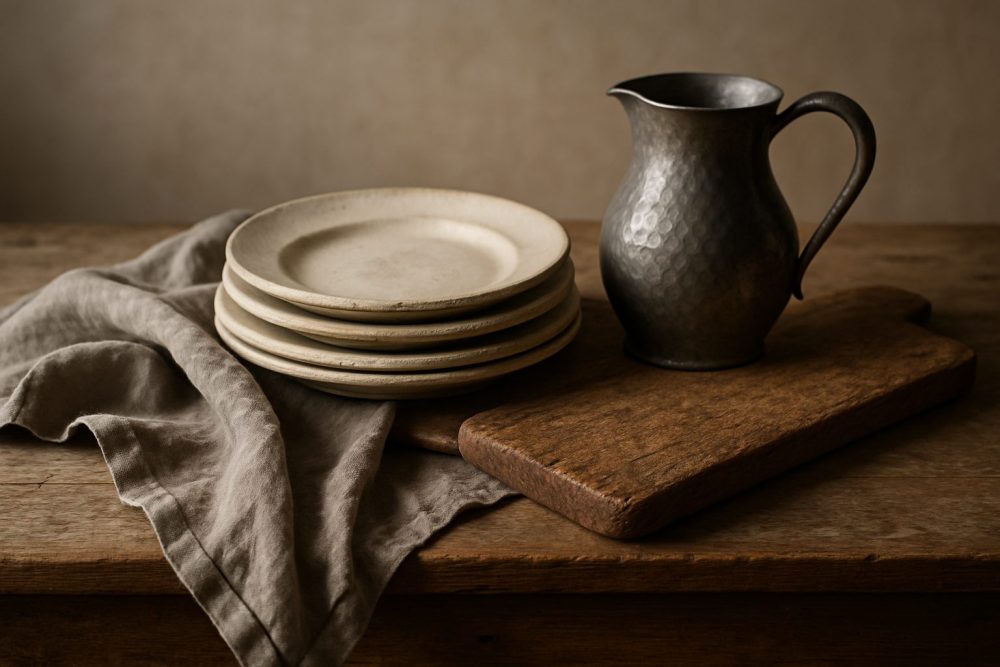
For textiles, reach for linen in undyed, natural, or stone-washed tones. The slightly rumpled quality of well-washed linen is exactly right for this aesthetic.
Layer runners in burlap, washed cotton, or rough-textured weaves across the table to add warmth and slight informality.
Ironstone is the correct answer for tableware on this type of table. Thick-walled, slightly irregular, and carrying the sensibility of farmhouse utility, it pairs naturally with industrial materials.
Aged pewter, hammered metal, or dark ceramic serving pieces carry the same materiality as the room’s larger anchor elements.
Harsh overhead lighting strips aged materials of the very quality that makes them interesting, so warm, soft light is non-negotiable.
Yale University design standards actually call for interior lighting between 2700K and 3000K to ensure soft white lighting in communal spaces. This color temperature promotes both relaxation and concentration without feeling sterile.
Candlelight does immense work here by casting moving shadows across reclaimed wood grain and catching the surface of hammered metal.
For overhead fixtures, Edison-style pendant lighting complements reclaimed wood and ironwork equally. This carries the right amount of industrial elegance without overpowering the historical space.
Key Insight: Lighting is the invisible layer of Old World design. Avoid cool-toned LEDs; instead, use warm, amber-hued bulbs and candlelight to reveal the deep textures in reclaimed wood and aged metal surfaces.
Putting It All Together
Old World style is not something you install in a single afternoon. It is a design philosophy built one deliberate piece at a time, and the rooms that achieve it best usually take a few seasons to find their true footing.
Start with the table, and let the reclaimed wood settle into the room to show you what it needs beside it.
Bring in the wall piece that starts conversations, and watch how the space changes register around it. When dressing the table and addressing the light, stick to materials that belong to the same historical conversation.
Linen, ironstone, wrought iron, aged brass, and warm filament glow all speak the same design language.
The final image worth building toward is a table set for dinner on a winter evening. Candlelight moving across the reclaimed grain, the steel of a mounted blade catching the glow from the wall, and linen pooling softly at the edges create a perfect atmosphere.
Taking the time to choose authentic pieces carefully is the secret to a room that feels like it has always been there.
Quote: Old World style isn’t about matching; it’s about the conversation between honest materials. A room feels timeless when every object looks like it was chosen for its soul rather than its trendiness.