
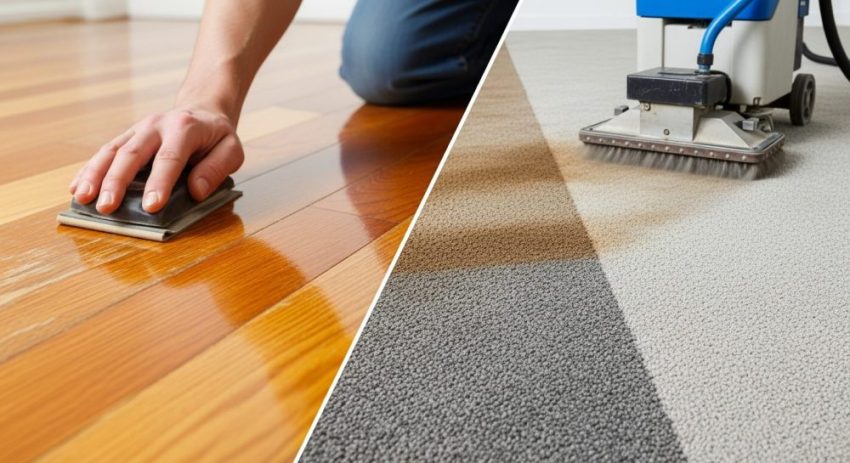
Keeping tired floors from dragging down a room’s mood is one of the most gratifying home improvement wins a DIYer can chase. Yet when you pull the furniture away and stare at that battered maple strip or dulled nylon pile, the big question pops up: do I refinish the hardwood, or do I restore the carpet that’s already here? Below, we’ll walk through the key considerations like cost, durability, health, sustainability, and plain old aesthetics so you can pick the route that makes the most financial sense and leaves your space feeling fresh rather than factory-new sterile.
Step One: Assessing What You Have
A smart refresh always starts with reconnaissance. Floor coverings age in wildly different ways, so a 15-minute survey can steer you away from spending money where it won’t matter. Modern inspection tools are surprisingly accessible. Even budget-minded homeowners can rent a moisture meter, a UV flashlight for urine spotting, and – yes – log their findings in carpet cleaning software that tracks stain location, fiber type, and cleaning chemistry history. This digital paper trail sounds nerdy, but it stops you from attacking a wool loop the same way you would a solution-dyed PET or from aggressively sanding a floor that only needs a buff and recoat.
If you’re eyeballing boards that still have at least ¹⁄₁₆-inch of wood above the tongue, refinishing is theoretically on the table. Conversely, a living-room frieze that still springs back underfoot and hasn’t lost more than 10% of its face yarn may deserve a revival rather than a landfill trip. Don’t rely purely on age; a 40-year-old carpet in a no-shoes household can outperform a five-year-old rental apartment installation. Measure, log, then decide; guessing costs money.
Specialized service businesses handling these projects need reliable ways to track scheduling, dispatching, and invoicing alongside their daily field notes. By adopting job management software like Mr Task, contractors can seamlessly photograph rooms, log chemical pretreatments, and tag sanding passes directly within the client’s file. Although a digital platform obviously isn’t a drum sander or an extractor, maintaining a strict, centralized timeline of every product and grit sequence applied makes troubleshooting significantly easier if a sealer fisheyes or a carpet stain wicks back.
Hardwood Refinishing: When Sanding Still Sings
Refinishing a wood floor is equal parts art and chemistry. Before you even plug in a sander, pull a baseboard section and verify thickness; countless 1950s oak floors are down to their last usable layer after decades of maintenance. If the wear layer is healthy, you’re in luck: solid hardwood is one of the few finishes you can repeatedly reset to “like new” status, and nothing boosts resale eye-ball appeal faster.
The Basic Workflow
True refinishing, stripping wood to bare grain, starts with a 36- or 40-grit cut that flattens cupped boards and removes finish. Two or three more sanding passes (60-, 80-, then 100-grit) erase drum marks. After vacuuming and tack-rags, a water- or oil-based sealer locks down the fibers, followed by two topcoats of polyurethane or hard-wax oil. Dry times vary from two hours per coat (water) to twelve (oil).
Yet the process is more nuanced than grit numbers. Temperature and relative humidity dictate open time; 68 °F and 45% RH is the sweet spot where finish flows but doesn’t blush. Rookie DIYers often forget edge blending: a random-orbit sander running the same sequence as the drum bridges those perimeter strips so no halo stands out once stain goes down.
Cost Snapshot
While the National Association of Realtors tracks refinishing’s high ROI, 2026 industry pricing confirms professional refinishing averages $3 to $8 per square foot, whereas DIY equipment and materials cost $1.50 to $5.00. Add 10% for edging discs, respirator filters, and floor-friendly painter’s tape you will definitely forget on trip one.
Pros
- Longevity. A full resand can reset a floor’s clock for another 15-20 years before the next deep intervention.
- Color Control. Stain or dye lets you pivot from orange 1990s oak to espresso or Nordic white without buying new boards.
- Hypoallergenic Finish.The EPA’s Indoor Air Quality guidelines confirm sealed wood flooring harbors significantly fewer dust mites than carpet, making it a critical upgrade for asthma sufferers.
Many owners report the space even “sounds” cleaner because a solid plank reflects sound more predictably than a tired carpet pad that swallows certain frequencies.
Cons
- Finite Wear Layer. Most solid flooring withstands four to six resands in its life. A ¾-inch-thick board installed in 1955 may already be on its last pass.
- Skill Curve. A moment’s hesitation with a drum sander can dish a plank. Fixing that requires time you could have spent planning your vacation.
- Temporary Evacuation. Even low-VOC finishes off-gas; pets and toddlers should be out of the house until the final coat cures.
After you’ve weighed those drawbacks, factor in optional upgrades: inlays, border staining, or filling gaps with resin tinted to match late-season growth rings. Each flourish elevates the outcome without adding another demolition cycle down the road.
Carpet Restoration: Beyond Shampoo and Hope
Carpet’s reputation for being “disposable” is half myth, half marketing. A methodical restoration often revives color depth and loft while costing less than 40% of replacement. Still, you must respect fiber science; over-wet a jute-backed woven rug, and you’ll cause shrinkage, but underheat a grease-matted polyester, and soil simply redistributes.
A quick primer before the deeper dive: synthetic fibers (nylon, olefin, and PET) respond to alkaline presprays for oily grime, whereas wool demands a pH below 8 to avoid cuticle damage. Fumbling that chemistry doesn’t just waste time – it can trigger dye bleed you’ll never fix.
Deep Cleaning Is Just the Start
Restoring isn’t a single machine pass. The gold-standard sequence looks like this:
- Dry-soil removal with a pile lifter.
- Prespray targeted to fiber type (alkaline for olefin soils, acidic for protein spills).
- Agitation with a counter-rotating-brush machine to open the yarn twist.
- Hot-water extraction at 200 °F and 400 psi, immediately followed by a balanced rinse agent.
- Post-grooming and rapid airflow to cut dry time under four hours.
Finish that final step and resist the urge to close the door. Carpets dry faster with cross-ventilation and a box fan nudging moisture toward an open window. Walkable softness returns the same evening, which is why many landlords schedule restorations between morning key-drop and afternoon leasing tours.
Advanced Fixes Most Homeowners Skip
Professionals stretch wrinkles with a lever-action power stretcher, not a knee-kicker found in big-box rentals. That matters because loose carpet wears 40% faster at the pull points. Where burning candles or pet claws created local damage, patch repairs splice in donor pieces stolen from a closet corner. Color revival kits, viable only on wool or nylon, bond acid dyes back into the fiber; they won’t hide bleach, but they can mute sun-fade lines on a bay-window edge. Finally, adding a new 8-lb rebond pad lifts comfort and can halve footfall noise during evening Netflix marathons.
Cost Snapshot
IICRC-certified technicians price deep cleaning between $0.20 and $0.50 per square foot, plus restorative add-ons. DIYers can rent an extractor for around $40 a day, with highly concentrated retail cleaning formulas costing just pennies per square foot.
Pros
- Minimal Disruption. Rooms are usable the same evening once air movers knock moisture down to 12% RH in the pile.
- Acoustic Warmth. Carpet softens footfall and dampens echo, especially prized in open-concept homes with cathedral ceilings.
- Insulation Boost. The R-value of carpet plus pad can hit 1.5, trimming a sliver off the winter heating load.
Consider the subtle ways carpet influences behavior. When the floor is inviting, children choose floor games over couch gaming. That lifestyle benefit rarely shows up in spreadsheets but shapes everyday happiness.
Cons
- Stain Memory. Certain spots – coffee tannins, red dye #40 – re-appear when humidity spikes. That “ghosting” is infuriating.
- Allergen Reservoir. Even freshly cleaned carpets will harbor pollen and skin flakes between fibers after two weeks of normal traffic.
- Lifespan Limit. A residential carpet installed in the early 2000s is nearing the end of its backing’s plasticizer life; no amount of steam can reverse latex deterioration.
Once the restoration honeymoon fades, you must commit to quarterly vacuuming with a sealed-HEPA machine if the goal is long-term fiber health. Slack on that, and soil behaves like microscopic sandpaper.
Crunching the Numbers: Value vs. Expense
When you put pencil to paper, sanding a 300 square-foot living room at $5.25 per square foot totals $1,575, while a high-spec carpet restoration may clock in at $525. That’s a dramatic delta. Yet amortized over realistic service life, things even out.
Below is a side-by-side look at total outlay per year of expected service:
| Scenario | Up-Front Cost | Service Life (yrs) | Maintenance Over Life | Cost per Year |
| Hardwood Refinish | $1,575 | 15 | $300 for three buff-and-recoats | $125 |
| Carpet Restore | $525 | 3 | $280 for two additional cleans | $268 |
The table shows what the eyeball test can hide: hardwood asks for more today but less every Christmas thereafter. If you plan to stay in the home longer than a Netflix free-trial, the wood often edges out.
Resale math tilts the scale further. The NAR Remodeling Impact Report shows refinished hardwood recovering 147% of costs at sale, while cleaned original carpets add no measurable appraised value.
After running those numbers, remember intangibles: the smell of fresh poly is brief, but buyers sniff out “new carpet” too, often wondering what stains are hiding underneath.
Sustainability and Indoor Air Quality Considerations
Landfilled carpet generates four billion pounds of U.S. waste annually. Despite take-back programs, near 9% is recycled into next-generation padding or plastic feedstock. So, prolonging carpet life through restoration is undeniably greener than ripping it out. Still, restoration chemicals must be rinsed properly; surfactant residue becomes a sticky soil magnet and can inflate a home’s VOC load if not neutralized.
Hardwood refinishing, meanwhile, keeps existing material in place and uses minimal consumables beyond sandpaper sheets and finish. VOCs remain the elephant in the room, but water-borne polyurethanes now average under 150 g/L, well below the standard 275 g/L compliance limits. Always ventilate and pick Greenguard Gold finishes to ensure formaldehyde off-gassing stays strictly under 0.0073 ppm after 14 days. An overlooked benefit: wood can later be re-milled into engineered flooring wear layers, extending its service life in a second building cycle rather than becoming biomass fuel.
For allergy sufferers, both paths beat tearing everything out today and installing new carpet, which vents styrene and butadiene during its first week. A properly cured floor – wood or textile – emits negligible irritants as long as routine cleaning or dust-mopping keeps particulates down.
Decision Matrix: Putting It All Together
To translate these concepts into a fast reference, here’s a matrix that merges both performance and lifestyle factors. Use it as a gut check after you’ve scoped your own square footage and timeline.
| Factor | Refinish Hardwood | Restore Carpet |
| Typical Cost (300 sq ft) | $1,300-$1,800 | $300-$700 |
| Expected Added Lifespan | 15-20 yrs | 2-4 yrs (before next deep clean) |
| DIY Difficulty | Moderate-High | Low-Moderate |
| Dust/Allergen Impact | Low post-cure | Moderate ongoing |
| Adds Resale Value? | Yes | Neutral |
| Sustainability Score | High | Medium |
No single column owns every checkmark. Choose based on which compromises you can live with. If your short-term budget is razor-thin but you need a quick visual win, carpet restoration wins the day. If you have room for a weekend of elbow grease (or the pro fee) and want a change that endures, lean into the drum sander.
Conclusion: A Floor You’ll Be Proud Of
Floors set the emotional temperature of a home. Whether you opt to unleash the hidden warmth of long-neglected oak or coax the existing carpet back into polite society, the key is informed planning. Map stains and damage with carpet cleaning software, photograph the subfloor, note moisture readings, and store it all in an organizer such as Mr Task so next year’s touch-up isn’t a mystery.
Refinishing hardwood rewards you with a decade or more of easy sweeps and a glow that never fully goes out of style. Carpet restoration, on the other hand, offers speed, softness, and less up-front cost – perfect when you’re staging the house for a near-future sale or you simply love how plush it feels under bare feet.
Neither path is intrinsically “better.” The winning choice is the one that stretches your dollars, preserves materials, and makes you actually want to kick off your shoes the minute you cross the threshold. Take the time to inspect, tally true costs over time, and choose the project that will keep your floors – old though they may be – feeling very much alive.